








ASSOCIATED PRESS — The United States captured Venezuelan President Nicolás Maduro and flew him out of the country in a stunning military operation early Saturday that plucked a sitting leader from office — the culmination of months of escalating Trump administration pressure on the oil-rich South American nation.
Maduro and his wife, taken overnight from their home on a military base, were aboard a U.S. warship on their way to New York, where they were to face criminal charges.
U.S. President Donald Trump said the U.S. planned to run Venezuela until a transition of power can take place. He claimed the American presence was already in place, though there were no immediate signs the U.S. was running the country. Venezuelan state TV continued to air pro-Maduro propaganda, broadcasting live images of supporters taking to the streets in Caracas in protest.
When asked what would happen if the U.S. ends up administering Venezuela for years, Trump suggested that the U.S. would use revenues from oil sales to pay for running the country, saying, “The money coming out of the ground is very substantial.”
“We’re going to get reimbursed for everything that we spend,” he said.
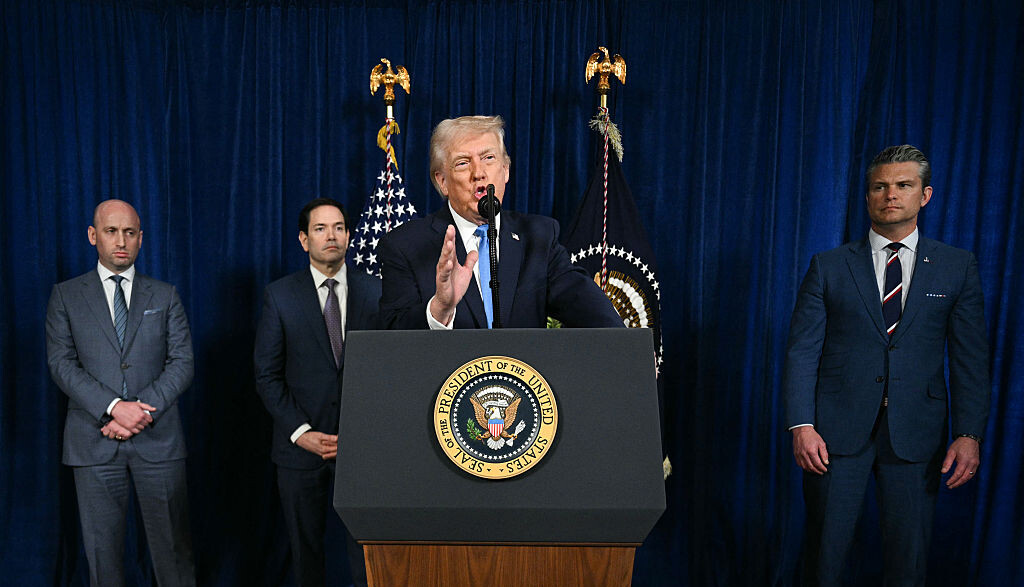
Trump said that the U.S. will be running Venezuela with a “group” and did not rule out the possibility of U.S. troops.
“We’re not afraid of boots on the ground,” Trump said at a news conference detailing the operation of Maduro’s capture. He added: “We’re going to make sure the country is run properly.”
He added the U.S. would fix the oil infrastructure in Venezuela, adding that “we’re going to get the oil flowing.”
When asked who would be running Venezuela, Trump said, “the people that are standing right behind me” are going to be running it “for a period of time.”
Gen. Dan Caine, the president’s top military advisor, said that more than 150 aircraft from 20 different bases were involved in the surprise, overnight attack on Venezuela that captured President Nicolas Maduro.
Caine said the aircraft included F-22, F-35, and F-18 fighter jets as well as B1 bombers and other support aircraft “as well as numerous remotely piloted drones.”
Caine said that the mission of the aircraft was to provide cover for the helicopters that acted as the “extraction force” with the goal of capturing Maduro and his wife.
“There were multiple self-defense engagements as the force began to withdraw out of Venezuela,” Caine said. He also said that the military chose “the right day to minimize the potential for civilian harm and maximize the element of surprise.”
The defense secretary likened the attack on Venezuela to the U.S. strikes on Iran last summer over that country’s nuclear program, saying that, “Maduro had his chance, just like Iran had their chance.”
He said adversaries of the U.S. should “remain on notice” that “America can project our will anywhere, anytime.”
“Welcome to 2026, and under President Trump, America is back,” he said.
Trump has repeatedly claimed without evidence that boats have been carrying drugs into the U.S. from Venezuela. But in fact Venezuela is not a major source of drugs to the U.S.
There is no evidence to suggest fentanyl comes from Venezuela. Rather, the vast majority of fentanyl that flows into the U.S. is transported in through Mexico, and often produced from precursor chemicals coming from Asia.
While a number of illegal armed groups are present in Venezuela, much of the cocaine flowing out from Venezuela is produced in Colombia and other Andean nations. The Caribbean is often used as a jumping-off point for drug traffickers to smuggle their product to European markets.

