

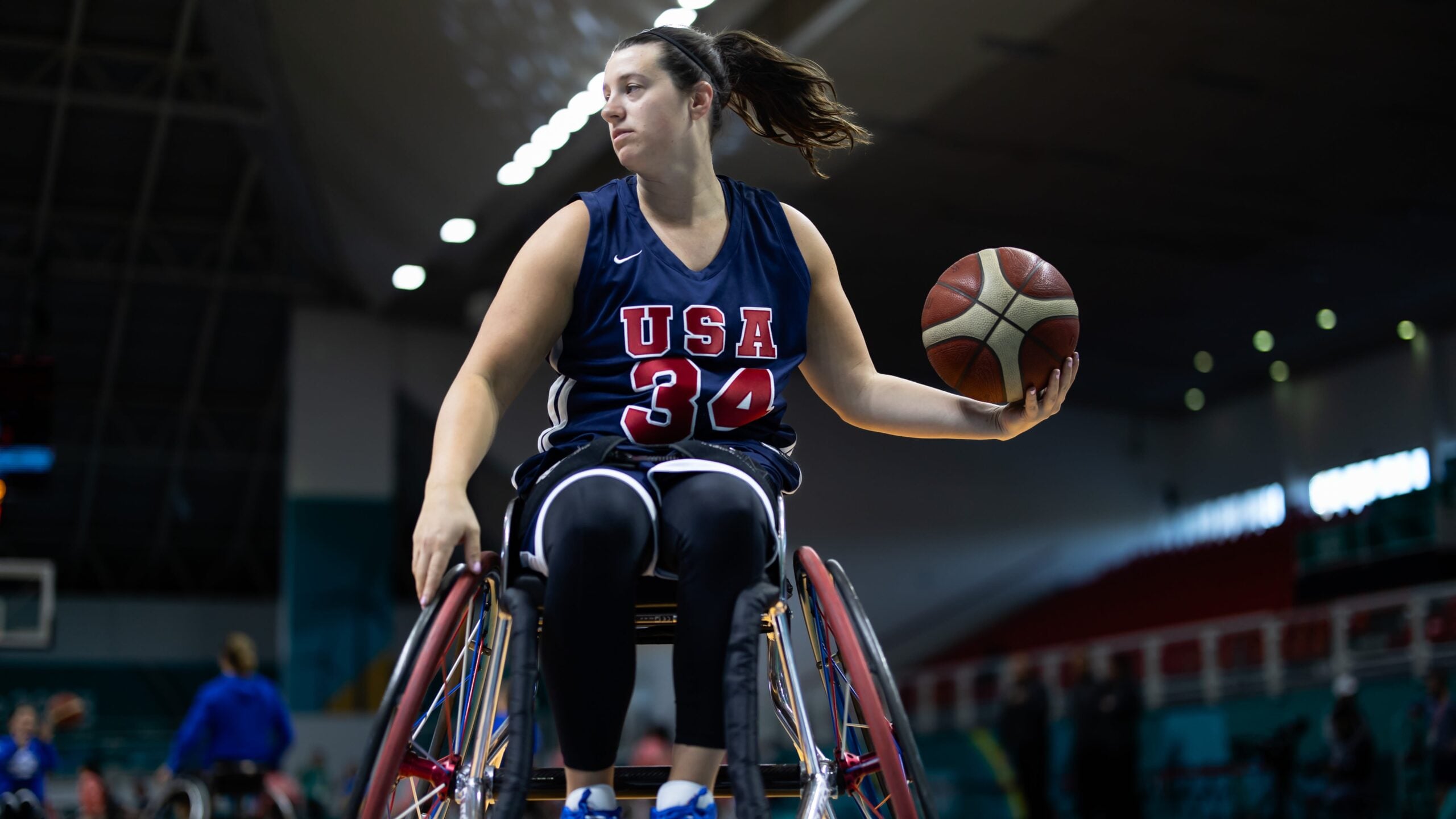
Brookfield’s Emily Oberst played multiple sports in junior high when her life suddenly changed with a diagnosis of Ewing’s Sarcoma. She tells WTMJ’s Libby Collins how after numerous surgeries, chemo, and rehab, she overcame the disease and embraced a new sport. Emily excelled in wheelchair basketball in college and set her sights on the world stage, and today on WTMJ Conversations, she shares what it was like to compete for Team USA in the Paralympics in 2024 and her goals for the 2028 games in L.A. It’s all ahead on this edition of WTMJ Conversations!
A partial transcript is provided below, courtesy of eCourt Reporters.
LIBBY COLLINS: So, at this point, you’ve got this guy who says you can play wheelchair basketball. You don’t like being in a wheelchair. How did you make the decision to try it?
EMILY OBERST: My mom, she forced me.
So, we went to practice. I was mind blown at how competitive and fast-paced and physical wheelchair basketball was. Like, the minute I saw their drills and they’re basically tackling each other and shooting three-pointers from a wheelchair, I was like, wait, I need to do this.
So, I got in a chair that night. I couldn’t even make a layup, because I had zero upper-body strength. Because in your wheelchair, it’s all upper body, you can’t get any power from your legs.
LIBBY COLLINS: Did you find that hard to coordinate at first?
EMILY OBERST: Oh, yeah, I — yeah, I dribbled the ball off my wheelchair, like, every time I tried.
But then as you become more skilled, it’s more of like you kind of throw the ball in front of you, and then you push and catch up to it. And then dribble again.
But I honestly fell in love that night and started playing.
LIBBY COLLINS: So, you get to that final game, and you were up against whom?
EMILY OBERST: The Netherlands. Yeah, they’ve won everything for the past decade in wheelchair basketball on the women’s side of things. They just like dominate in our world. We had them for a little, and then we just — we couldn’t make a damn basket in the gold medal game. When that happens, there’s not much you can do. But honestly, silver was still great.
My favorite moment was we beat China by three points in the semifinals to make it to the gold medal game. So, that was amazing just knowing we had a guaranteed medal.
LIBBY COLLINS: Getting even a silver medal at the Paralympics, I can’t even imagine what kind of a high that must have been.
EMILY OBERST: A lot of Team USA athletes always debate this: So, like, would you rather win bronze or lose silver? And I hate losing; it is my least favorite thing in the world. But I am so grateful to have that silver medal. And it’s a higher place. It’s great, but we’re going to get gold in L.A.