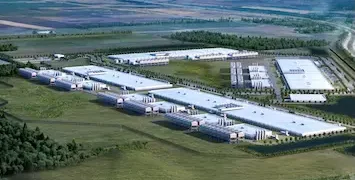











The term “hyperscale” is a new category for infrastructure in Wisconsin — it refers to data center projects that are significantly larger than anything the state has seen before. These colossal campuses designed to handle massive amounts of data and computing tasks have arrived in full force, as the companies behind them seek to meet rapidly growing demands for cloud services, and now artificial intelligence.
The hasty arrival of hyperscale data centers leaves Wisconsin’s manufacturers and contractors, utility companies and lawmakers in uncharted situations — and many Wisconsinites wary of the lack of regulation for unprecedented projects.
Wisconsin Data Center Coalition
Until the most recent data center construction boom fueled by AI investment, Wisconsin wasn’t getting the same kind of attention from developers as regions like Silicon Valley or Virginia. Now that hyperscale projects are taking root in all corners of the Badger State, the Wisconsin Data Center Coalition has emerged to connect developers with in-state businesses.
“Our companies haven’t had the same opportunities that their counterparts in other parts of the country have had,” Executive Director Tricia Braun told WTMJ. “But if we don’t start getting our companies involved now, we may miss the boat.”
Some Wisconsin businesses have already entered the data center supply-chain network, from medium-size entities to small machine shops. La-Crosse-based Trane Technologies is building structural components like copper tubing, and Milwaukee-based Rockwell works with multiple local businesses to make the motor for chillers.
“It’s this aggregate supply chain that creates a multiplier effect,” said Braun. “There’s probably 16 of those chillers on each data center build. And then you look at the air handling units, the server boxes themselves, some of the battery systems, and the generation systems for the actual operation of the data center.”
The coalition doesn’t have official numbers published for state economic impact projections or results, but plans to in the future, according to Braun. She said manufacturing in the region generally has an economic multiplier of 2-4 — meaning for every job created by a company, an additional two to four jobs are created in its direct supply chain. In a data center project, that multiplier can be six or higher.
New electric rates and consumer pushback
The quantities of energy needed to power hyperscale projects are so massive that Wisconsin’s utility companies don’t have existing rate classes designed for such capacity requirements.
We Energies has proposed a “Very Large Customer” (VLC) rate class — a 10-year contract for projects of 500 megawatts or more — designed to ensure most of the costs needed to build new power generation for hyperscale projects are paid for by the data center companies, instead of falling to other We Energies customers. But last week the utility asked for another rate hike for residential customers to help recover the costs of constructing new energy projects.
Even before the rate hike announcement, community advocacy groups have criticized the VLC request for not going far enough to protect other ratepayers.
“In a neighborhood like Lindsey Heights on the north side of Milwaukee. . . the majority of the people spend more than 5-6%, even 10-20% of their income just on energy,” Antonio Butts, Executive Director of Walnut Way Conservation Corp said during a community discussion on data centers at Riveredge Nature Center. “In a situation where costs of everything are going up, that becomes a real life or death choice.”
Some local lawmakers have also chimed in. The Milwaukee Common Council unanimously adopted a resolution opposed to We Energies’ proposal.
“Large data center customers should be required to pay 100% of all incremental and fixed costs required to serve them, full stop,” Alderwoman Marina Dimitrijevic said.
The state regulatory body of public utilities, Public Service Commission (PSC) of Wisconsin is expected to vote on the VLC rate class in early May, and decide on the residential rate hike proposal by the end of the year.
In central Wisconsin, Alliant Energy filed its own custom rate proposal with the PSC to address the Meta data center campus in Beaver Dam. But instead of creating a separate electric rate that would apply to any future projects of similar scale, the utility proposed an individual contract rate agreement with Meta.
Last month the PSC ordered Alliant to file a new application, after finding that the utility’s original submission contained too many redactions, including the amount of energy the campus will need and how long the contract would last. A new application shows Alliant expects to supply up to 220 megawatts to the data center campus for a term of 10 years.
It’s unclear if the PSC will vote on the Alliant proposal before or after the We Energies proposal, but whichever gets the green light first will likely set a precedent for future large customer rate structures.
Regulations stall in the State Senate
State regulations don’t exist for hyperscale data centers, save for a single Wisconsin statute regarding tax incentives. The State Assembly passed a Republican-authored bill in January that aims to protect ratepayers, limit environmental impacts and guarantee land restoration. But the bill did not come up for a vote in the State Senate on its final floor session day.
Assembly Speaker Robin Vos called the issue “bigger than most that I have seen in my 22 years” in the state legislature.
“The basic idea that we want to ensure that locals have control over it should be things that are bipartisan,” he told reporters following a WisPolitics and State Affairs luncheon. “So I don’t know why the Senate wouldn’t bring that up.”
Both chambers are expected to be done for the year, unless Governor Tony Evers calls a special session this spring.
The State Senate during its final session day also failed to take up a bill that seeks to end the use of non-disclosure agreements (NDAs). The legislation would prohibit companies and local governments from using NDAs and other secrecy deals to conceal information about data center projects from the public or local officials.
“Residents are concerned about noise levels, environmental impacts and infrastructure costs, and how the project will affect the quality of life,” said the bill’s sponsor, Republican State Senator André Jacque.
The bill aims to give local communities more time to review proposed projects in full, and would prevent a local government from approving a data center if it violates transparency requirements.
Just days after the NDA bill passed with bipartisan support in Senate committee, Microsoft announced it will no longer use non-disclosure agreements with local governments, including all existing agreements. The tech giant is in the process of building 15 more data centers near its existing campus in Mount Pleasant.
So far at least Beaver Dam, Kenosha, Janesville, Menomonie and Beloit have signed NDAs for data centers that are proposed or already under construction.
Public opinion on hyperscale data centers remains low, with 70% of Wisconsin voters saying the costs are greater than the benefits, according to a Marquette University Law School Poll. That sentiment also showed up at the polls on Tuesday: Port Washington passed the first referendum in the nation that could restrict future data centers, by giving voters in the city a say when approving large tax incremental financing districts.