










MILWAUKEE– In it’s first meeting, the Milwaukee Public School’s Committee on Student Achievement and School Innovation (SASI) discussed how well students have improved their literacy and mathematics skills.
In a presentation that focused on the overview of K3-Grade 12 assessments for the ’25 to ’26 school year, MPS Director of Research Assessment and Data Dr. Natalie Collins and Jennifer Minsel say that across the board students averaged close to about 9.5 hours of testing compared to the ’24-’25 school year where students averaged about 8 hours of testing.
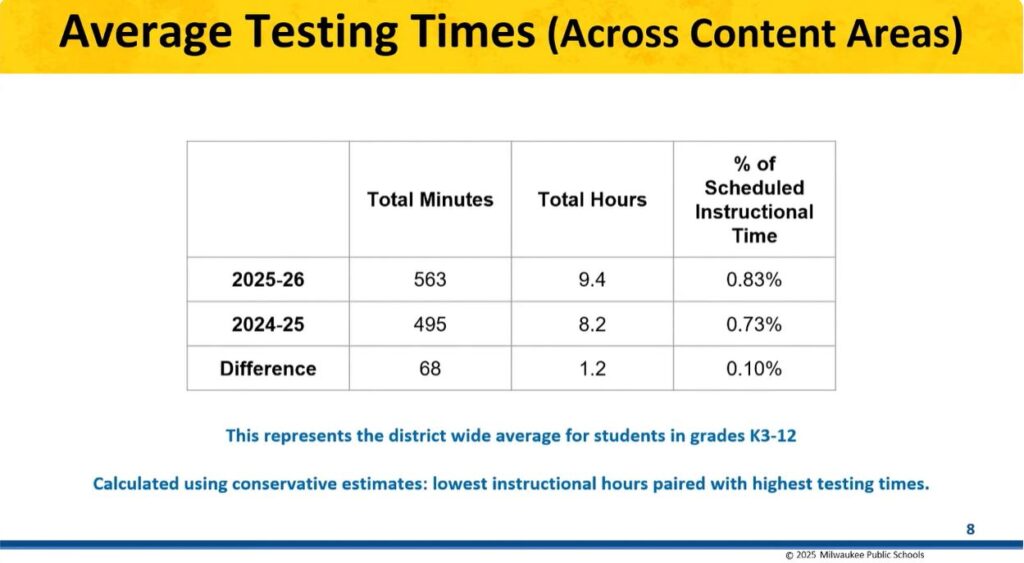
“We have conducted a thorough review of the federal, state and district required assessments and calculated these averages,” said Dr. Collins. “These averages were calculated conservatively by pairing the lowest pair on instructional hours at a grade-level school, but then using the highest testing times across the different assessments and grade levels. So this means the figures represent the maximum possible impact on instruction time rather than the typical testing experience.”
But members of the Milwaukee Teachers Education Association tell a different story.
MTEA President Ingrid Walker-Henry says the number of tests in classrooms has risen sharply in an effort to improve district literacy rates and those numbers were not reported by the district.
“The power point of assessment testing times is inaccurate. Elementary testing times this fall have increased dramatically by 50% to 100% across all content areas,” said Walker-Henry. “MPS did not meet and confer with members of the MTEA, the union representing teachers about these non-mandated assessments. Second, MPS imposed these non-mandated assessments without considering the wide array of school programs and curriculum across the district.”
Henry-Walker continued and pointed out one week where students in grades 3 through 4 tested more than 10 hours in one week.
“In one week in September, following the MPS PACE guides for 3rd grade, the students were forced to be tested for 630 minutes. That is 10 and a half hours of testing in one week. This is developmentally inappropriate,” said Walker-Henry. “The administration’s roll-out of literacy for the ’25-’26 school year remains in crisis and it remains unworkable for teachers.”
Walker-Henry asked that the presentation be redone to cover both mandated and non-mandated reporting within the school district to give a fully accurate description of testing among students.
Jennifer Minsel responded by saying all MPS teachers are able to collect data on students as they finish course modules which helps the district assess how well students are advancing in their education.
District Superintendent Dr. Brenda Cassellius said that she would talk with Walker-Henry after the committee hearing to better discuss and address how assessments are done.